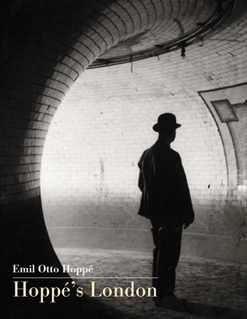
Cloth, 80pp, 8.5"x10.5"
Guiding Light, London, 2006

Cloth, 80pp, 8.5"x10.5"
Guiding Light, London, 2006
Emil Otto Hoppé: Hoppé's London
Book Release and London Exhibition
Exhibition at the Michael Hoppen Gallery, London, accompanied by the release of the first new book on Hoppé in sixty years.
In the early 20th century, E.O. Hoppé began one of the most unique photographic documents of London where for over forty years he worked tirelessly to record London’s transition from a 19th century city into a modern metropolis. Systematically chronicling the landmarks and architectural fabric that defined the city of London, Hoppé’s work can be compared both in scale and modernistic approach to Eugene Atget’s photographs of Paris, and Bernice Abbott’s of New York.
“His compositions sometimes take the ‘bird’s-eye view’ of modernism and are often composed with taut geometry. He photographed the new electric city of the 20th century with its glittering neon advertising and the illuminated plate glass windows of department stores. He relished seeking out the cosmopolitan types of docklands and of Soho, and recording the various national festivals that have been transplanted to London. He photographed a subject that was to attract many later photographers—his pinstriped, top-hatted bankers in their morning coats anticipate the photographs of Robert Frank. As do his series taken from a London bus and his photographs of the intimate conversation of chairs in London parks. One of his photographs shows a man standing in a tiled tunnel of the Underground. Hoppé’s work is, naturally, full of cross-references to his peers and successors.”
— From the book essay by Mark Haworth-Booth
— Visiting Professor of Photography, University of the Arts, London
— Honorary Research Fellow, Victoria and Albert Museum, London
Background on E.O. Hoppé
German-born British photographer Emil Otto Hoppé (1878-1972) was the most celebrated portrait and topographic photographer of the Modern era. Contemporaneous with Edward Steichen, Alfred Stieglitz, and Walker Evans, Hoppé was described by British photographer Cecil Beaton simply as “The Master.” His now rare photographic books from the 1920s and 30s on America, Great Britain, and Germany—classics in photographic literature—show Hoppé’s pioneering Modernist style that was largely formative and influential in the practice of photographic art in the first half of the twentieth century.
Hoppé studied portrait photography in Paris and Vienna before moving to live in London in 1900. In 1907, after winning first prize in a contest sponsored by the London newspaper the Daily Mail, Hoppé left banking to open a portrait studio in London’s Baron’s Court. His photographs of arts celebrities such as Thomas Hardy, George Bernard Shaw, A.A. Milne, T.S. Eliot, G.K. Chesterton, Leon Bakst, Vaslav Nijinsky and the dancers of the Ballets Russes quickly earned him the reputation as the top celebrity photographer in London. His passion for street photography and his pioneering efforts in photographic art, along with his naturalistic studies, were widely celebrated in the US, Britain, and Europe. In 1913 he expanded his studio to the Kensington house of the late painter Sir John Millias, occupying all thirty-three rooms with his burgeoning operation.
By 1919 Hoppé tired of his work and sought
travel to foreign countries to photograph self-assigned subjects.
His large-format gravure-printed photographic
books about “Fair Women” (1922),
Great Britain (1926), the United States (1927), Germany (1930 and 1932),
Australia (1931), and India (1935) were likely to have influenced his contemporaries.